DeepSeek V4.1 Flash vs Muse Spark 1.3: Price, Context and Coding Compared

By Olivia Hart
MyClaw Editorial
MyClaw
Run Best-in-Class AI Agents Now
Run OpenClaw or Hermes Agent on managed MyClaw hosting, so your AI agent stays online, updated, and ready for real work.
AI Takeaway
- What are we comparing? DeepSeek V4.1 Flash is DeepSeek's multimodal model, announced September 10, 2026 and called through the API name
deepseek-flash. Since October 17, 2026 that name is served by DeepSeek-V4.1-Flash-1017, a minor weight update with the same API method and pricing (vendor-stated). Muse Spark 1.3 is Meta's agentic and coding model, calledmuse-spark-1.3. - How do the API prices compare? DeepSeek lists $0.30 for fresh input and $1.20 for output at peak, per million tokens, with off-peak at half. Meta lists $1.25 for input, $0.15 cached and $4.25 for output in standard mode (vendor-stated, read October 17, 2026).
- Which accepts more kinds of input? Both read images and answer in text. Meta also lists PDF and video input for Muse Spark 1.3, while DeepSeek describes native visual understanding.
- Which one is open? DeepSeek publishes the V4.1 Flash and 1017 weights on Hugging Face under the MIT License (vendor-stated). Muse Spark 1.3 is API-only, and Meta's open-weight release, Muse Spark Open, is its own model.
- Can an agent host handle this for me? A general hosted agent on MyClaw is covered near the end. Neither model is claimed to run on it.
DeepSeek V4.1 Flash vs Muse Spark 1.3: The Quick Verdict
Put simply, DeepSeek's model is the budget-friendly, open-weight pick with a fresh update, while Muse Spark 1.3 is Meta's hosted model with the wider list of input types. We did no hands-on testing for this piece. Each number is lifted from a vendor page and dated, and neither maker benchmarks against the other. Prices in particular change often, so recheck them on the vendor pages before you budget. For the Meta side in more depth, start with our Muse Spark 1.3 explainer.
| DeepSeek V4.1 Flash | Muse Spark 1.3 | |
|---|---|---|
| Maker | DeepSeek | Meta |
| API name | deepseek-flash | muse-spark-1.3 |
| Window | Roughly one million tokens | Just over one million tokens |
| Accepts | Text plus pictures | Text, pictures, PDF files, video |
| Weights | MIT License, Hugging Face | Not released |
| Input price | $0.30 peak, $0.15 off-peak | $1.25 |
| Output price | $1.20 peak, $0.60 off-peak | $4.25 |
What DeepSeek V4.1 Flash Brings
DeepSeek's announcement calls V4.1 Flash the smallest model in its new architecture family, built for faster inference and higher throughput. The company says its key-value cache needs a quarter of the memory and an eighth of the disk space of the previous generation, which it argues cuts the cache-hit costs that dominate agent bills. You can run it with or without visible reasoning, structured JSON replies and function calls work, and the older Flash names now route to it.
Pricing follows a peak and off-peak scheme, and DeepSeek says off-peak rates are half of peak. So if you can run flexible jobs at quiet hours, the same work simply costs less. Our Flash and Pro comparison shows how it differs from the bigger sibling.
The 1017 Update
On October 17, 2026, DeepSeek's changelog said V4.1 Flash had been upgraded to DeepSeek-V4.1-Flash-1017 on the API, web and app. The calling method and prices stay the same, so deepseek-flash simply points at the new version. The Hugging Face page calls it a minor update with the same architecture, configuration and tokenizer, changing only the weights.
DeepSeek reports gains over the launch version, such as Terminal-Bench 4.0 rising from 31.2 to 42.3 and DeepSWE v1.1 from 74.2 to 77.0, plus shorter outputs and faster runs. Those are vendor-reported on DeepSeek's own harnesses. Some third-party gateways already list the update under its own model ID.
What Muse Spark 1.3 Brings
Meta describes Muse Spark 1.3 as trained for agentic workflows and tuned for competitive coding, with max reasoning for hard tasks and native perception of images, video and documents. The Model API accepts text, images, PDF and video and returns text. Its 1,048,576-token window is shared by the input and the requested output, and a request that exceeds it is rejected rather than trimmed.
Meta sells two modes. Standard mode lists $1.25 on the way in, $0.15 for cached tokens and $4.25 on the way out, per million. Contributor mode costs $0.10, $0.002 and $0.20, but Meta says that data is used to improve its products. Web search grounding is billed separately, at $2.50 per thousand queries. Another rival gets its turn in our GLM Flash matchup.
Price, Peak Hours and Real Costs
DeepSeek's pricing page (read October 17, 2026) lists, per million tokens, $0.30 at peak and $0.15 off-peak for fresh input, $0.006 and $0.003 for cached input, and $1.20 and $0.60 for output. Meta's Model API page (read October 17, 2026) shows $1.25, $0.15 and $4.25 with no extra charge for long context.
Here is our own rough math: sending 2 million fresh tokens and getting 200,000 back would list near $0.84 at DeepSeek's peak rates, $0.42 off-peak and $3.35 on Meta's standard mode. Caching, reasoning length and retries change real bills, so measure one task before you scale.
Context, Inputs and Output Limits
Both models offer a window of roughly a million tokens, enough for large codebases or long document sets. DeepSeek lists up to 384K output tokens, while the Meta quickstart configuration shows a 131,072-token output limit. That gap matters if you want whole files or long reports in a single reply.
On inputs, Meta's list is wider, with PDF and video on top of images. DeepSeek's documentation emphasizes visual understanding and shows vision as supported on its Flash model. If your work revolves around documents or clips, confirm the exact formats with each vendor first.
Benchmarks and What They Do Not Show
DeepSeek's Hugging Face table for the 1017 update compares it with other vendors' models, among them Kimi K3 and GLM-5.3, but Muse Spark is not in it. Meta's model page publishes its own table against other companies' models and does not list DeepSeek. So no honest number-to-number comparison exists, and we make none.
Each table also uses its maker's chosen harnesses and settings. Treat them as hints about what each team tuned for, then try your own jobs. One small run on your real prompts says far more than a leaderboard row, and it takes an afternoon at most.
DeepSeek V4.1 Flash vs Muse Spark 1.3: Pros and Cons Compared
Pros for DeepSeek V4.1 Flash
- Lower listed API prices, with half-price off-peak hours.
- Open weights under the MIT License.
- Large output cap and a fresh 1017 update.
Cons for DeepSeek V4.1 Flash
- Peak and off-peak pricing makes budgeting less simple.
- Narrower list of documented input types.
- Gains for 1017 are vendor-reported.
Pros for Muse Spark 1.3
- Accepts PDF and video as well as images.
- Clear single price with no long-context premium.
- Documented tool and harness setup.
Cons for Muse Spark 1.3
- Higher listed prices.
- Weights are not released.
- Contributor mode trades lower prices for data use.
Choosing for Your Workload
Go with DeepSeek V4.1 Flash for high-volume text and vision jobs where price matters, especially if you can schedule work off-peak or want open weights to run yourself. Choose Muse Spark 1.3 when PDFs or video are part of the input, or when you prefer Meta's tooling and one steady rate.
If you want a third opinion, our Kimi K3 matchup pits an older Flash against another big model. Whichever you try, begin with three real tasks and compare cost, retries and time.
A Friendly Agent for Everyday Work: MyClaw
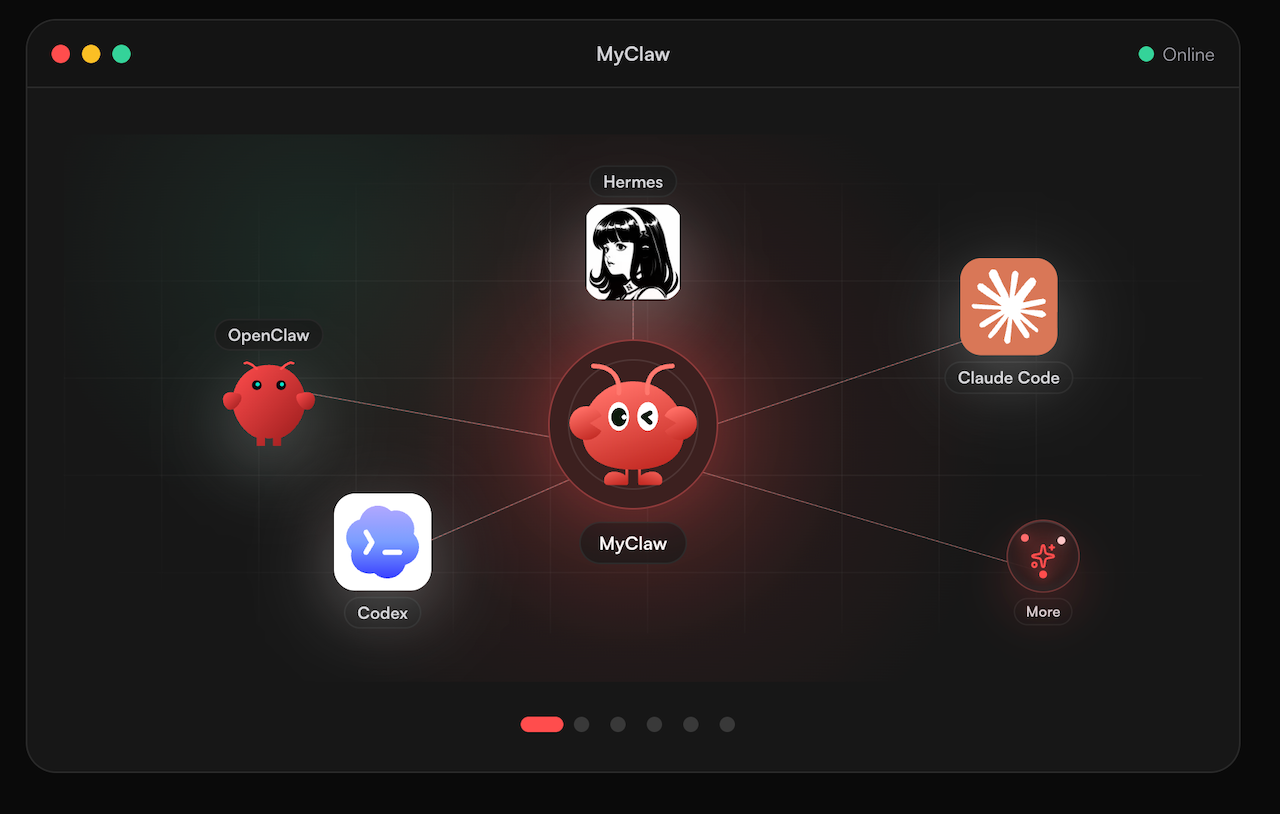
If juggling models feels like a lot, there is a calmer way in. MyClaw gives you a general-purpose agent that someone else hosts: managed OpenClaw or Hermes, awake around the clock. Talk to it in your chat app or a browser, and let it reach the documents, apps and information you share.
Most popular models work with it. In plain terms it costs less than Meta's Muse Spark does, though we skip numbers because they move. DeepSeek V4.1 Flash and Muse Spark are not claimed to run there. For the basics, try OpenClaw explained or the Hermes agent page.
- Set up a hosted agent in MyClaw.
- After that, connect your chat app (any messenger works) and share the files or tools it needs.
- Give it one small recurring chore and watch how it handles it.
Conclusion
DeepSeek V4.1 Flash and Muse Spark 1.3 land in different places: DeepSeek on price and open weights, Meta on input types and one simple rate. No neutral test separates their quality yet, so what you test yourself decides it. Check the vendor pages again before you budget, because both companies adjust prices and snapshots often. If you would rather not manage models at all, MyClaw's hosted agents are a friendly place to begin.
Skip the Setup, Run Best-in-Class AI Agents Now
Launch a managed OpenClaw or Hermes Agent workspace in minutes, with always-on hosting, updates, and support handled by MyClaw.