Gemini 4 Carbon Review: Price, Benchmarks, and High Thinking

By Alex Morgan
MyClaw Editorial
MyClaw
Run Best-in-Class AI Agents Now
Run OpenClaw or Hermes Agent on managed MyClaw hosting, so your AI agent stays online, updated, and ready for real work.
AI Takeaway
- Is Gemini 4 Carbon generally available yet? Not for most developers. Google’s October 28, 2026 announcement describes a limited Fairwind and cyber-defender rollout; broader access is still “coming soon.”
- What is the Gemini 4 Carbon price? From the announcement: introductory $2 per 1M input and $10 per 1M output, then $4 / $20 after the intro window, with cached input at 95% off the input rate—the same intro path Google described for Argon.
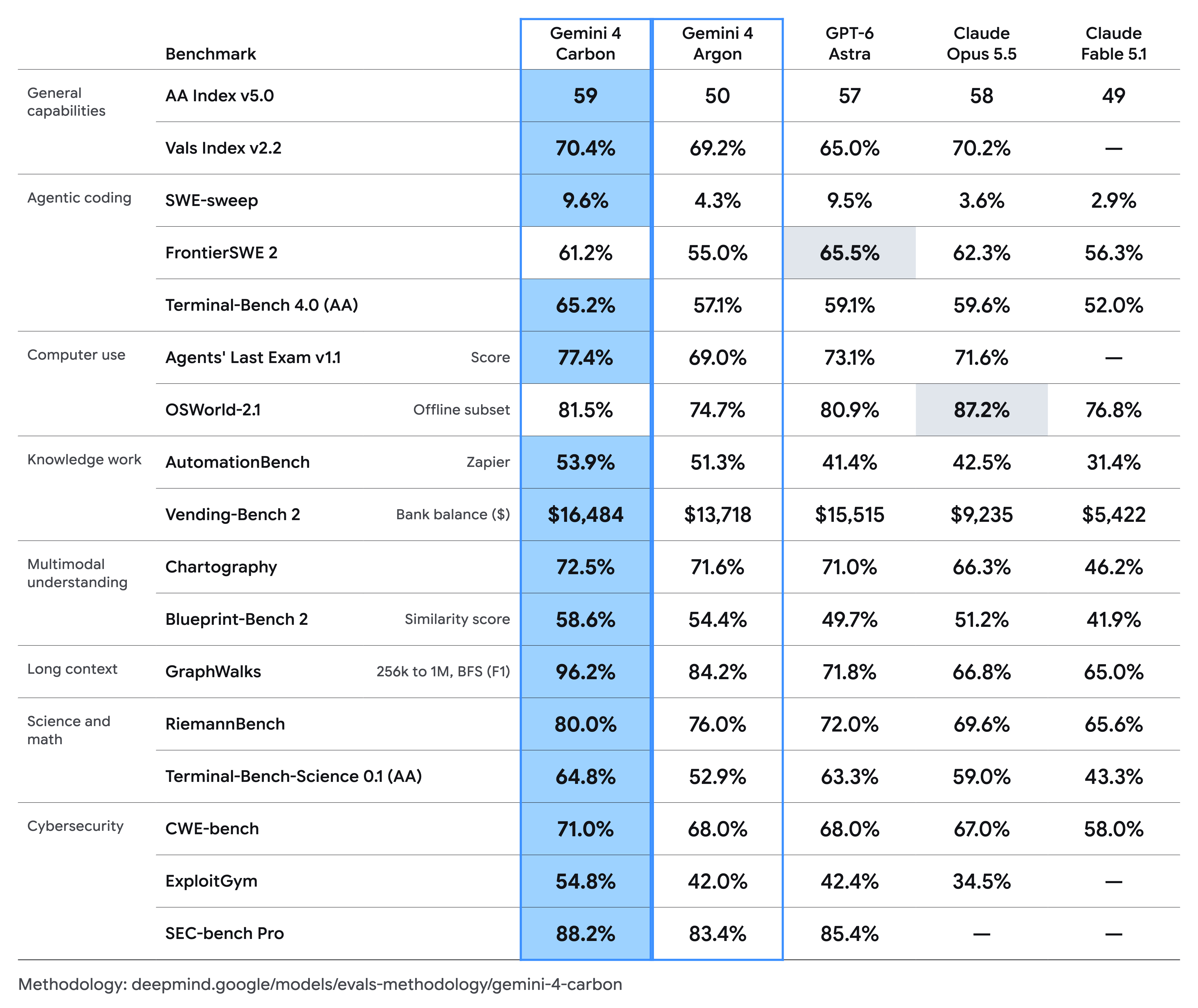
- Which Gemini 4 Carbon benchmarks stand out? Google and DeepMind publish Artificial Analysis Intelligence Index v5.0 at 59, plus SEC-bench Pro 88.2%, ExploitGym 54.8%, and CWE-bench 71.0% (cyber suites evaluated without guardrails).
- What does Gemini 4 Carbon high mean? High is the Gemini 4 family thinking level that maximizes reasoning depth. “Carbon (high)” is a third-party scoreboard label for that setup—not a product name invented here.
- Where does MyClaw fit today? MyClaw hosts always-on OpenClaw/Hermes agents for models you already run. This review does not claim MyClaw offers Gemini 4 Carbon.
Gemini 4 Carbon at a Glance
Gemini 4 Carbon is Google’s next frontier model after Gemini 4 Argon, announced October 28, 2026. Google frames it for long-horizon engineering and cybersecurity defense: find vulnerabilities, check exploitability, propose patches. Rollout starts with a subset of cyber defenders, then trusted Fairwind partners, before general developer and consumer access. The launch post also cites WebDev Arena at +89 Elo to #4 (1768). For Argon while Carbon stays gated, see Gemini 4 Argon.
Price figures below come from that announcement. Benchmark numbers come from the Google Blog and DeepMind tables checked November 2, 2026 (Asia/Seoul). Most teams still cannot call Carbon on a public Developer API key today.

Gemini 4 Carbon Price
Gemini 4 Carbon price in this review is the Google announcement, not a live public invoice. On October 28, 2026, Google said Carbon launches at Argon’s introductory rates: $2 per million input tokens and $10 per million output tokens, with cached input at 95% off the input token price. After the introductory period, Google states $4 per 1M input and $20 per 1M output.
Use that post as the published rate path. The Gemini Developer API pricing page (last updated October 30, 2026 UTC, checked November 2, 2026) still lists Argon’s calendar windows—$2/$10 through November 30, 2026 and $4/$20 from December 1, 2026—without a separate Carbon row. Until Carbon shows up as a billable public SKU and your project has access, treat the announcement as the price path and assume the API may not bill Carbon yet. Cached input helps most when long agent traces re-read the same system prompt and tool schemas.
Gemini 4 Carbon Benchmarks
Gemini 4 Carbon benchmarks in Google’s materials lean into cyber defense and agent work. The October 28, 2026 blog cites Artificial Analysis Intelligence Index v5.0 at 59 (ranked #1 in Google’s framing), SEC-bench Pro at 88.2% for finding vulnerabilities, ExploitGym at 54.8% for exploitation checks, and Collinear’s CWE-bench at 71.0% for patching. Google notes those cybersecurity evaluations ran without guardrails—worth remembering before you copy a score into a production policy.
DeepMind’s Gemini models page (checked November 2, 2026) repeats the Index and cyber trio and adds Carbon-column results such as Vals Index v2.2 at 70.4%, FrontierSWE 2 at 61.2%, Terminal-Bench 4.0 (AA) at 65.2%, Agents’ Last Exam v1.1 at 77.4%, OSWorld-2.1 offline at 81.5%, GraphWalks at 96.2%, and RiemannBench at 80.0%. Google also claims more than 2× secure-code success versus Argon and a Chrome “>10X” high-quality patch rate versus another lab’s frontier model; those stay Google-reported here, not independently reproduced. For related Gemini 4 reading, see Gemini 4 Argon vs Opus 5.5 and Gemini 4 vs GPT-6 Astra.
Treat cyber scores as ceilings under permissive eval settings. Production still needs allowlists, human review on exploit paths, and regression suites that match your CVE surface—not Index rank alone.
Gemini 4 Carbon High
Searches for Gemini 4 Carbon high usually point to the high thinking configuration, not a different model family. Official Gemini thinking docs (checked November 2, 2026) define thinkingLevel / thinking_level for Gemini 4 Argon as low, medium (default), and high. High maximizes reasoning depth: more thinking tokens, a slower first non-thinking output token, and a better fit for hard code, math, science, and long agent loops.
This review treats high as that Gemini 4 family thinking level. When a scoreboard prints “Carbon (high),” it is labeling Carbon evaluated at high thinking—not inventing an API id. Once you have access, run the same hard tasks at medium and high before you standardize. Medium still fits interactive coding; save high for multi-step exploit validation, long patch reasoning, and heavy agent loops where depth beats latency.
Until Google publishes a Carbon-specific thinking table row and a public model id you can paste into a client, skip invented endpoint names. Use Argon’s documented levels as the family reference and keep third-party “Carbon (high)” columns as evaluation labels.
Pros and Cons
Pros:
- Cybersecurity scores lead Google’s own comparison set: SEC-bench Pro 88.2%, ExploitGym 54.8%, CWE-bench 71.0% (Google Blog / DeepMind, October–November 2026 checks).
- Artificial Analysis Intelligence Index v5.0 at 59 is a clear headline number next to strong long-horizon and coding rows on DeepMind’s table.
- Announced Gemini 4 Carbon price path mirrors Argon’s intro then $4/$20 shape, so token budgets can start from known math once access opens.
- Google reports alignment and prompt-injection gains in the launch post, including 0.0% successful cheating on Terminal-Bench 4.0 in its framing.
Cons:
- Access is still limited; most teams cannot validate Carbon on their own workloads yet.
- The public Developer API pricing page (updated October 30, 2026) still lacks a Carbon SKU, so announcement pricing may not equal a billable endpoint today.
- High thinking raises token use and first-token latency—fine for hard cyber or agent jobs, costly for shallow prompts.
- Independent Artificial Analysis reporting (checked November 2, 2026) gives Carbon a leading AA-Omniscience score but a higher hallucination rate than Argon: 11% versus Argon’s 4%, even as accuracy rises—so factual reliability needs task-level testing, not Index faith alone.
Who Should Wait vs Who Should Watch the Rollout
Cybersecurity and secure-engineering teams with Fairwind or defender access should watch Carbon first; the published find–exploit–patch stack is the clearest differentiator versus Argon. Product and platform teams without access should keep shipping on models they can call today, track GA, and reuse Argon evaluation harnesses so Carbon can drop into the same suite later. If always-on scheduling is the bottleneck—not the next frontier name—start with agent hosting: OpenClaw Getting Started for recurring jobs, and Best Hermes Agent Hosting when you compare managed Hermes-style options.
If you already run multi-hour agents against repos and infra, prepare prompts, tool schemas, and safety gates now so a Carbon key can plug in without rewriting the stack.
Run Always-On Agents With MyClaw
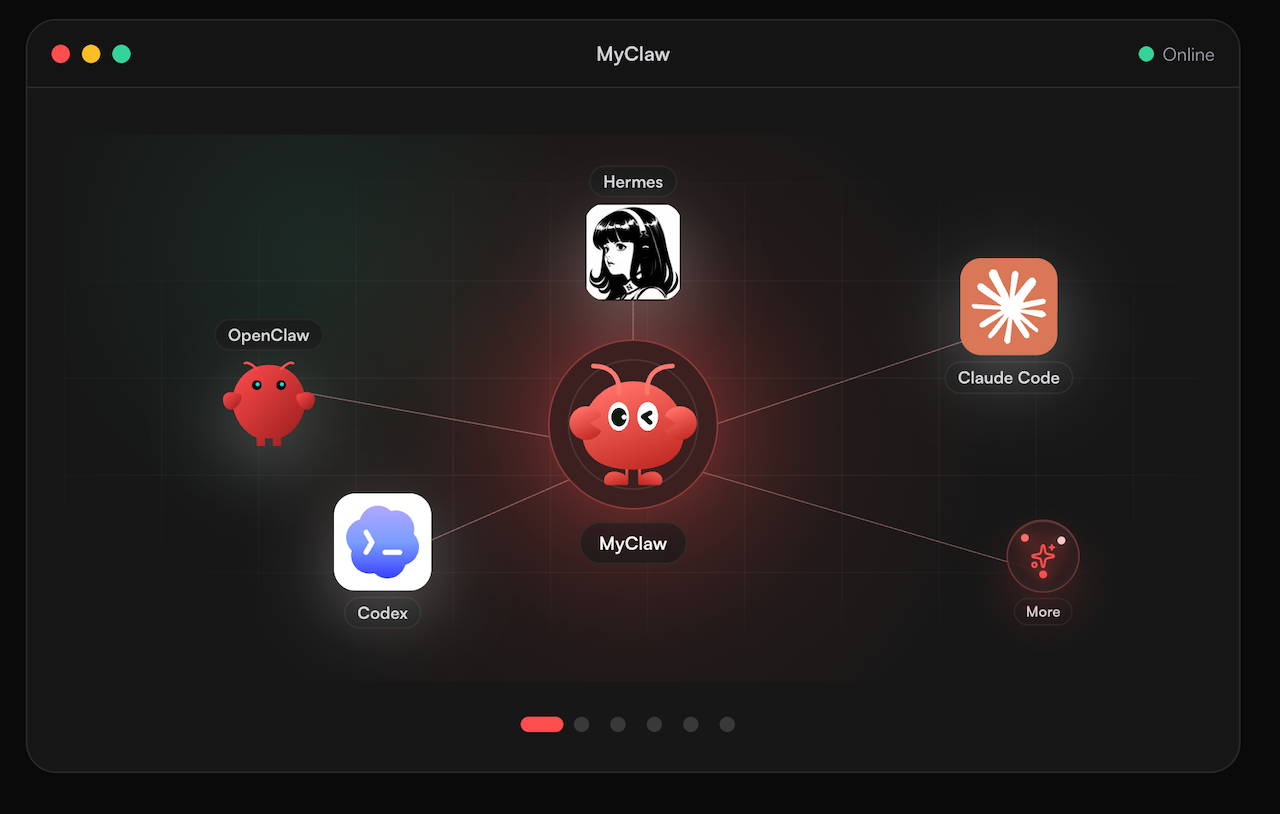
MyClaw is managed OpenClaw/Hermes agent hosting—always on, with scheduled jobs and no server for you to babysit. It works with most popular models. This Gemini 4 Carbon review does not claim MyClaw runs Gemini 4 Carbon. For the OpenClaw stack itself, see What Is OpenClaw.
Carbon may still sit behind Fairwind or defender access; the overnight work around it does not. A security engineer can leave an OpenClaw agent on MyClaw to pull dependency advisories after midnight, draft a short triage note for each new CVE that hits their repos, and park it for morning review. A solo developer who cannot watch chat all day can wake up to a digest—failed CI, stale PRs, vuln-looking mentions in yesterday’s commits—without renting a VPS. Wire the models you can already call; when Google opens Carbon, swap or add it in the same workspace instead of rebuilding the schedule.
- Create a MyClaw workspace and connect the models and skills you are already authorized to use.
- Define the recurring work—repo checks, alert triage, digests—and attach schedules so the agent keeps running after you close the laptop.
- Review logs and tighten prompts or tools as the jobs stabilize; expand model choices only when a provider actually grants you access.
The agent is still there at 3 a.m.; change the model when access and billing show up.
Conclusion
Gemini 4 Carbon’s launch pitch is strongest on cybersecurity and long-horizon work: Index 59, a published price path from intro $2/$10 toward $4/$20, and a clear cyber score stack. Read Gemini 4 Carbon high as maximum Gemini 4 thinking depth; “Carbon (high)” is a third-party eval label, not a made-up API id. The practical limiter today is access and billing—the Developer API may not bill Carbon yet—not the spreadsheet math. Use MyClaw for always-on OpenClaw/Hermes agents on models you can already run, keep Argon harnesses ready, and revisit Carbon when Google opens the door to your account.
Skip the Setup, Run Best-in-Class AI Agents Now
Launch a managed OpenClaw or Hermes Agent workspace in minutes, with always-on hosting, updates, and support handled by MyClaw.