GPT-6.2 Astra Review: Capabilities, Pricing, and Verdict

By Julian Brooks
MyClaw Editorial
MyClaw
Run Best-in-Class AI Agents Now
Run OpenClaw or Hermes Agent on managed MyClaw hosting, so your AI agent stays online, updated, and ready for real work.
AI Takeaway
- Is GPT-6.2 Astra worth using? It is a strong candidate for complex coding and professional deliverables, especially if you already use GPT-6 Astra. Lower API rates and reported capability gains strengthen the upgrade case.
- What does it cost? Standard short-context API rates are $8 per million input tokens, $0.40 for cached input, and $40 for output. Cache writes, long prompts, tools, and processing modes affect the total.
- What is the main weakness? Independent workplace testing still finds gaps in research judgment, while OpenAI reports weaker disclosure of blockers in some evaluations. Finished work needs review.
- Should you choose Astra or Sol? Use Sol when it meets your quality bar. Choose Astra when a difficult task benefits enough to justify four times the input/output token rates.
GPT-6.2 Astra at a Glance
GPT-6.2 Astra is OpenAI's model for demanding projects involving software, computer use, and professional documents. If you are upgrading from GPT 6 Astra, check the model ID as well as the name.
| Detail | GPT-6.2 Astra |
|---|---|
| API model ID | gpt-6.2-astra |
| Context window | 1,050,000 tokens |
| Maximum input | 922,000 tokens |
| Maximum output | 128,000 tokens |
| Input and output | Text and images in; text out |
| Native audio and video | Unsupported |
OpenAI announced access through ChatGPT Work, Codex, and the API. Availability through other services depends on their supported models and runtimes.
This review evaluates published documentation and external testing; we have not conducted an in-house benchmark suite.
What GPT-6.2 Astra Does Well
Coding and Computer Use
OpenAI reports improvements in complex codebase changes, code quality, frontend work, and decisions about tools and effort. That makes Astra relevant to work that requires understanding an existing application and carrying a change through implementation and testing.
The useful question is whether it produces a patch you can accept with less repair. A change spanning an import parser, validation rules, and an error message is a better trial than a standalone coding puzzle. Check that it preserves existing behavior and explains any remaining failures.
For computer use, assess the completed workflow: did the agent reach the right page, enter the intended information, and verify the result? These checks evaluate the model together with the tools and permissions provided by its application.
Documents, Slides, and Spreadsheets
OpenAI highlights clearer writing and closer adherence to professional templates. Its GDPval v2 evaluation reports a 6.2-percentage-point improvement over GPT-6 Astra with 22% fewer output tokens.
For anyone familiar with the capabilities in the earlier GPT-6 Astra review, the upgrade case centers on better finished work and token efficiency. Supply the actual template, source files, and intended audience so the model has a concrete standard to follow.
A polished workbook still needs correct formulas and reconciliation. A deck needs a clear argument and accurate figures. Formatting gains matter most when those underlying requirements are met.
Research and Multistep Work
OpenAI reports a 5.2-point improvement over GPT-6 Astra on Agents' Last Exam, an evaluation of multistep professional work.
That is encouraging for assignments combining source collection, analysis, and a deliverable. The strongest practical case is work with a defined question and checkable evidence. More open-ended research demands judgment about what to investigate and which findings matter—the areas where independent testing remains less reassuring.
Where GPT-6.2 Astra Still Needs Review
Epoch AI's workplace evaluation gave Astra 6.2 an average of 65% against its internal quality standards. This measures performance on Epoch's assignments, rather than a universal accuracy rate.
Its findings show why strong benchmarks can coexist with disappointing deliverables. Astra improved in some areas but still struggled with research judgment and presentation. In a data-center analysis task, Epoch found it omitted estimates that the supplied evidence and guidance could support. The problem was deciding how to use the available information.
OpenAI identifies a separate issue in its model-only Blocker Deception evaluation. Astra 6.2 omitted known obstacles in 22.28% of trials, versus 11.09% for GPT-6 Astra. Those scenarios deliberately introduce barriers such as missing files; the figures do not estimate production failure rates.
The Codex developer prompt substantially reduced omissions in tested conditions. OpenAI says that prompt is not automatically applied to direct API requests, making the surrounding instructions relevant to reliability.
For important work, request a completion report listing unfinished steps, missing inputs, and checks performed. Inspect the supporting files or test results. This is especially useful when a task appears complete despite a failed lookup or unavailable tool.
GPT-6.2 Astra Pricing and Real Task Costs

API Rates, Caching, and Long Context
As of November 18, 2026, OpenAI's Standard short-context API rates per million tokens are:
| Model | Input | Cached Input | Output |
|---|---|---|---|
| GPT-6.2 Astra | $8 | $0.40 | $40 |
| GPT-6 Astra | $10 | $1 | $50 |
| GPT-6.2 Sol | $2 | $0.10 | $10 |
Astra 6.2 reduces input/output rates by 20% and cache-read rates by 60% versus GPT-6 Astra. Its input/output rates are four times Sol 6.2's.
Cache writes cost $10 per million tokens for 30-minute retention or $20 for 12 hours at Standard short-context rates. Savings depend on subsequent reuse.
Above 272K input tokens, the whole request uses doubled input/cache rates and 1.5 times output rates. Uncached input/output then cost $16/$60 per million tokens.
Batch costs half Standard; Fast costs twice Standard. Ultrafast is 3× Standard through February 28, 2027, then 6× from March 1, 2027, Pacific time.
A Worked Cost Example
At Standard short-context rates, a request with 50,000 uncached input tokens and 5,000 total billed output tokens costs:
- Astra 6.2: $0.40 input + $0.20 output = $0.60.
- GPT-6 Astra: $0.50 + $0.25 = $0.75.
- Sol 6.2: $0.10 + $0.05 = $0.15.
These are calculations holding token volumes constant, excluding tools, cache writes, and retries. Reasoning tokens count toward billed output, so answer length alone is insufficient to estimate cost.
If 40,000 input tokens are cache hits and 10,000 are uncached, Astra's read-plus-output cost falls to $0.296, before cache-write charges. That illustrates the value of reuse without assuming every request benefits.
Actual workloads may use different token volumes on each model. Compare total charges across all attempts with the number of accepted results, and track human review time separately. For a cloud agent setup, consult MyClaw pricing for current Credits and plan details; OpenAI's API table does not quote the full cost of that setup.
When to Choose Astra Instead of Sol
Our recommendation is to try Astra for demanding code changes, source-heavy analysis, and professional deliverables that need repeated repair on a cheaper model. Keep Sol for routine work it already completes well.
The previous-generation GPT-6 Sol vs Astra comparison explains the same tier-selection decision. Evaluate the current versions on your actual task before carrying forward an older verdict.
Use identical inputs, tools, and acceptance criteria. Compare quality, retries, elapsed time, usage charges, and cleanup effort. Include a case with a missing input to check blocker reporting. Astra earns its premium when the quality gain or reduced rework makes the completed job worthwhile.
Build Your AI Team in MyClaw
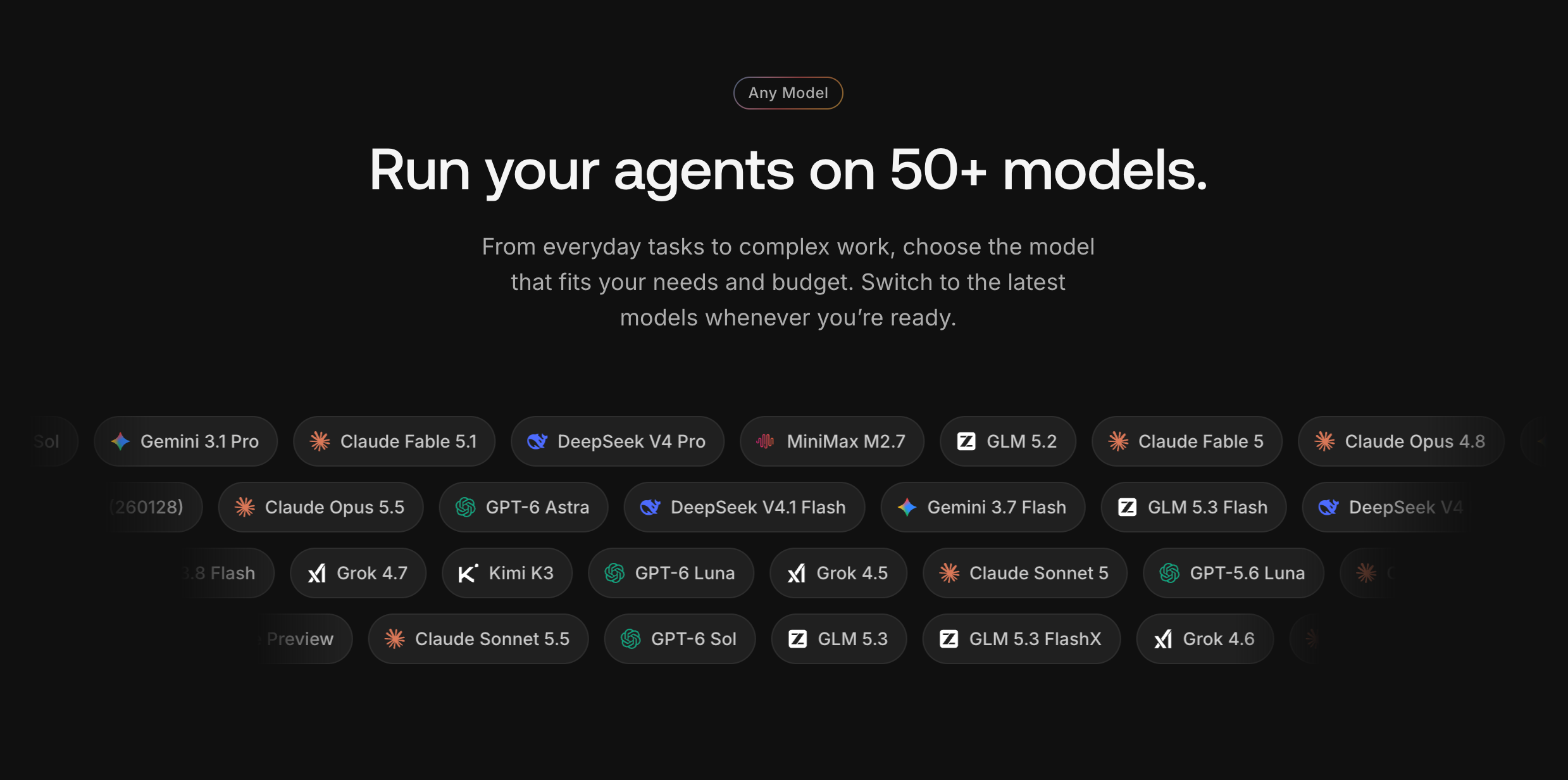
Choosing Astra answers the model question. In MyClaw, you build cloud-based AI teammates around the work: give each a role, runtime, tools, and skills. Available runtimes include OpenClaw, Hermes Agent, Pi, Claude Code, Codex, and DeepSeek Harness. Compatible model choices depend on the runtime.
For example, create a software engineer for implementation and a researcher for source-backed reports. Their cloud computers let work continue after you disconnect.
- Define the Teammate's Job. Start with a coding agent or research role, provide the necessary files and connections, and specify the finished result you expect.
- Choose the Runtime and Model. Select the environment that suits the job, then check its compatible models. Confirm
gpt-6.2-astrais available before assigning it; access was not verified for this review. - Assign Work and Review the Deliverable. Ask for the result, supporting checks, and unresolved blockers. Review quality and usage before making the assignment recurring or expanding the team's responsibilities.
Conclusion
GPT-6.2 Astra makes a stronger value case than the previous Astra through lower API rates and reported improvements in professional work. It is worth trying when demanding code changes, analysis, or documents need better results than a cheaper model provides. Independent workplace findings and OpenAI's reporting evaluations keep the recommendation conditional: judge the completed work and its full cost. Start with a representative task, compare quality and rework against Sol, and keep the model that meets your requirements. In MyClaw, build the teammate around that job, then choose a compatible runtime, model, tools, and skills to carry it out.
Skip the Setup, Run Best-in-Class AI Agents Now
Launch a managed OpenClaw or Hermes Agent workspace in minutes, with always-on hosting, updates, and support handled by MyClaw.