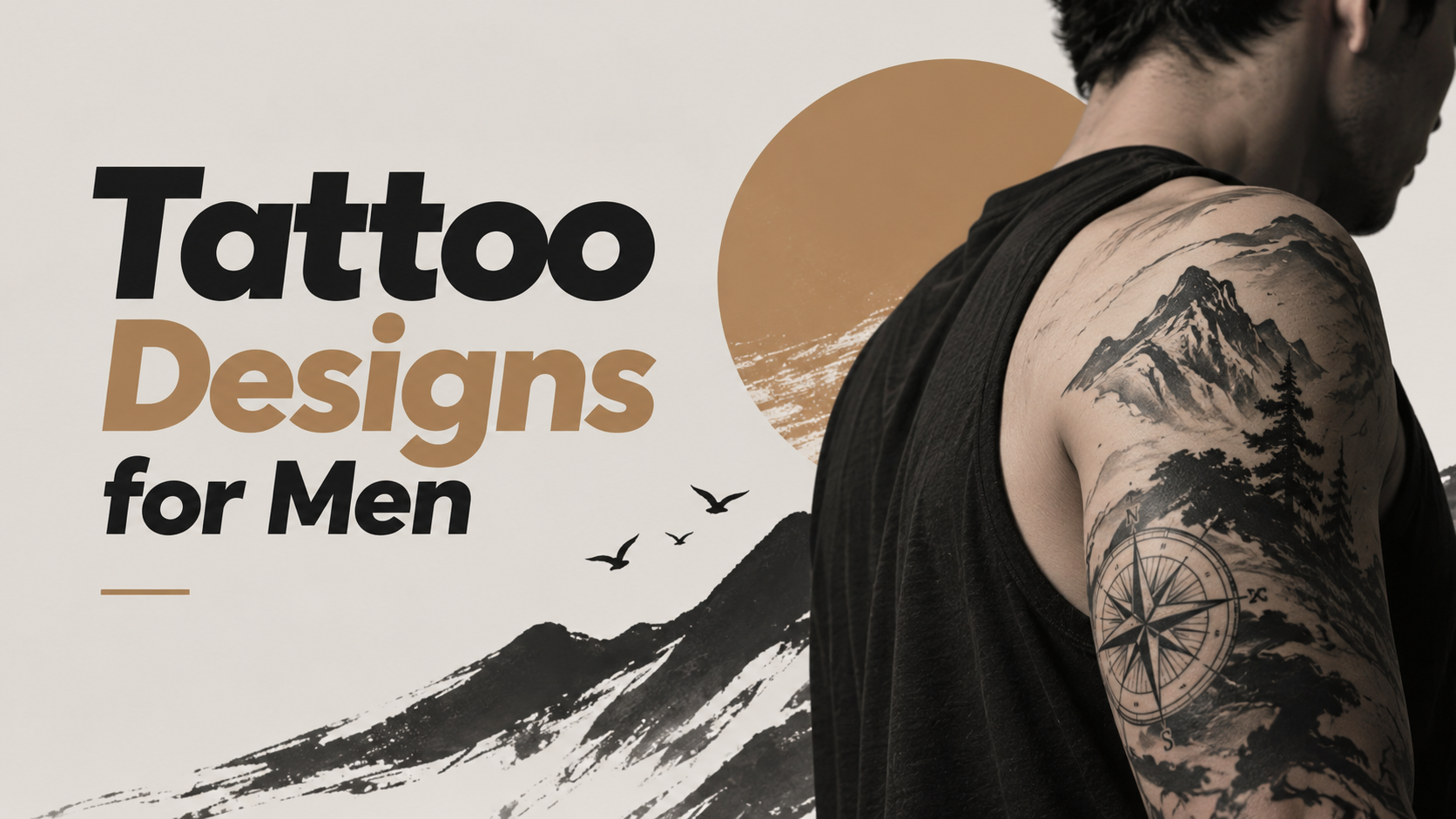
Tattoo Designs for Men: 18 Meaningful Ideas & Placements

By Emma Reed
MyClaw Editorial
MyClaw
Run Best-in-Class AI Agents Now
Run OpenClaw or Hermes Agent on managed MyClaw hosting, so your AI agent stays online, updated, and ready for real work.
AI Takeaway
- What makes a good tattoo design for a man? A strong design connects a personal reason with a style, scale, and placement that work together.
- Which designs work well as small tattoos? A compass, mountain, coordinates, initials, or a single wing can remain clear at a modest size because each relies on one recognizable shape.
- What do angel tattoos commonly mean? Protection, faith, remembrance, courage, struggle, and redemption are common themes, but the wearer’s story should define the final meaning.
- Can an AI tattoo generator create the final tattoo? It can produce a useful concept reference. A tattoo artist should still adapt the line weight, spacing, anatomy, and final stencil for real skin.
How to Choose a Tattoo Design You Will Still Want Later
Start with the reason, then decide visibility, size, and placement. A wrist tattoo needs a simpler silhouette than a shoulder piece, while a sleeve needs flow between elements. If you have no subject yet, use a few random tattoo ideas to identify what attracts you. Match the style to the space, then apply a one-sentence test: if you cannot explain why the tattoo matters to you, rethink the concept.
18 Tattoo Designs and Meanings for Men
A strong tattoo is defined by how well its image, style, scale, and placement express the intended story—not by a fixed idea of masculinity. The meanings below are starting points, not universal definitions. Research cultural and religious symbols in their proper context.
Small and Minimalist Tattoo Designs for Men

Small tattoo designs for men work best when one shape carries the idea. Simplify the concept instead of shrinking a portrait, landscape, and lettering into space suited to an icon.
| Design | Common meaning | Style direction | Placement and scale |
|---|---|---|---|
| 1. Compass | Direction, purpose, or finding a way through change | Fine-line, geometric, or traditional | Inner forearm, wrist, or calf; small to medium |
| 2. Mountain outline | Endurance, perspective, or a challenge overcome | Minimal linework or blackwork | Forearm, ankle, or upper arm; small to medium |
| 3. Coordinates | A private link to a place or turning point | Clean lettering with restrained spacing | Ribs, forearm, or upper arm; small |
| 4. Initials or a date | Family, memory, or a milestone | Script, serif, blackletter, or an ambigram concept when the words genuinely suit it | Chest, wrist, or inner arm; small |
| 5. Single feather or wing | Freedom, guidance, or remembrance | Fine-line, illustrative, or blackwork | Forearm, shoulder blade, or ankle; small to medium |
Designs About Strength, Change, and Resilience

These familiar motifs feel more personal when the pose, expression, or supporting elements connect to a specific experience rather than a generic idea of strength.
| Design | Common meaning | Style direction | Placement and scale |
|---|---|---|---|
| 6. Lion | Courage, leadership, or protective strength | Black-and-gray realism, blackwork, or traditional | Chest, shoulder, or upper arm; medium to large |
| 7. Wolf | Loyalty, instinct, independence, or belonging | Realism, geometric, or illustrative | Upper arm, calf, or forearm; medium |
| 8. Eagle | Freedom, vision, or personal identity | American traditional, realism, or blackwork | Chest, back, or shoulder; medium to large |
| 9. Snake | Transformation, rebirth, danger, or healing | Traditional, Japanese-inspired, or fine-line | Forearm wrap, calf, or thigh; medium |
| 10. Phoenix | Survival and renewal after loss or change | Illustrative, Japanese-inspired, or color realism | Back, chest, thigh, or upper arm; medium to large |
| 11. Skull | Mortality, defiance, or respect for life’s limits | Traditional, realism, or blackwork | Forearm, upper arm, chest, or calf; medium |
Angel Tattoo Designs for Men

Angel tattoo designs for men range from one restrained wing to a full scene. Faces, feathers, armor, and clouds consume space quickly, so detailed work needs a larger canvas.
| Design | Common meaning | Style direction | Placement and scale |
|---|---|---|---|
| 12. Guardian angel | Protection, guidance, or remembrance | Black-and-gray realism or illustrative | Forearm, chest, shoulder, or back; medium to large |
| 13. Angel wings | Freedom, spiritual protection, or remembrance | Fine-line, blackwork, or realism | Chest, back, or paired shoulder blades; medium to large |
| 14. Warrior angel or Archangel Michael | Courage, justice, faith, or defending one’s values | Realism, engraving, or blackwork | Sleeve, chest, or back; large |
| 15. Fallen angel | Struggle, rebellion, loss, or redemption | Dark realism, blackwork, or illustrative | Back, chest, thigh, or outer forearm; medium to large |
Personal Story Designs
| Design | Common meaning | Style direction | Placement and scale |
|---|---|---|---|
| 16. Memorial portrait or object | A person, pet, place, or shared memory | Realism, illustrative, or simplified black-and-gray | Upper arm, chest, thigh, or back; medium to large |
| 17. Family emblem or tree | Lineage, connection, responsibility, or growth | Blackwork, engraving, or illustrative | Chest, upper arm, back, or forearm; medium |
| 18. Nature scene or animal pairing | A personal place, relationship, season, or character trait | Illustrative, realism, or woodcut | Forearm, calf, thigh, or back; medium to large |
Portraits need enough scale to preserve likeness. If you begin with a personal photograph, use a focused photo-to-tattoo workflow to preserve important landmarks while removing irrelevant detail. Check family emblems for origin and associations, and compose landscapes for the body area rather than forcing a square image onto a curved limb.
Match the Design to Placement and Scale
Placement is part of the design. A vertical guardian angel can follow the forearm, while a lion’s face may fit the shoulder. Compare forearm, upper-arm, and sleeve ideas before planning a larger arm piece.
| Placement | What works well | What to watch |
|---|---|---|
| Wrist or ankle | Symbols, dates, short lettering, simple outlines | Movement, sun exposure, and limited room for detail |
| Forearm | Vertical motifs, lettering, medium compositions | High visibility and the need to follow the arm’s taper |
| Upper arm or shoulder | Portraits, animals, rounded or expanding designs | How the image changes as the arm turns |
| Chest or ribs | Personal symbols, wings, memorial work | Torso movement, symmetry, and a potentially demanding session |
| Back or thigh | Detailed angels, portraits, and narrative scenes | Larger commitment and the need for a strong overall silhouette |
| Sleeve | Connected themes and flowing compositions | Future expansion; isolated images can be difficult to connect later |
View the concept at its intended size. If an eye, letter, or feather disappears at a glance, simplify it. Ask your artist how the placement, skin, healing, and long-term wear should affect the design.
Turn Your Idea Into a Custom Tattoo Concept With MyClaw
The MyClaw Tattoo Generator turns a written idea or reference into flat concept art. Use it to compare visual directions before a consultation—not as a verified body preview or ready-to-use stencil.
1. Describe the Meaning, Motif, Placement, and Size
Name the subject, meaning, style, body area, approximate dimensions, color choice, and exclusions. Request flat artwork on a plain background so you can judge the silhouette clearly.
For example: “Create a black-and-gray guardian angel tattoo concept for the outer forearm, about 7 inches tall. Use an engraving-inspired style, a calm expression, one clear wing silhouette, and open space around the sword. Show flat artwork on a plain light background, with no skin mockup, text, or extra scenery.”
2. Generate Distinct Directions and Refine One Variable at a Time
Compare two or three distinct directions. Change one factor per pass—line weight, pose, negative space, or one supporting element—then check whether the silhouette still reads at thumbnail size.
3. Save the Strongest Reference for Your Tattoo Artist
Keep one or two labeled concepts with the size, placement, must-keep details, and exclusions. A tattoo artist can then adapt the anatomy, spacing, line hierarchy, and final stencil.
Before You Take a Design to the Tattoo Studio
Verify spelling, dates, religious imagery, and culturally specific symbols. Meanings can change across places and traditions.
Use references to explain silhouette, line weight, and negative space instead of copying someone else’s finished tattoo. Prepare a custom tattoo design brief with the exact body side, size, color preference, must-keep elements, and exclusions. Expect the artist to redraw the concept for your anatomy and long-term readability.
Choose a Design You Can Explain in One Sentence
The strongest tattoo combines a personal reason, a readable idea, and a placement that supports the composition. Test two directions, choose the one you can explain without borrowing someone else’s story, and let your artist turn it into a design made for your body.
Skip the Setup, Run Best-in-Class AI Agents Now
Launch a managed OpenClaw or Hermes Agent workspace in minutes, with always-on hosting, updates, and support handled by MyClaw.